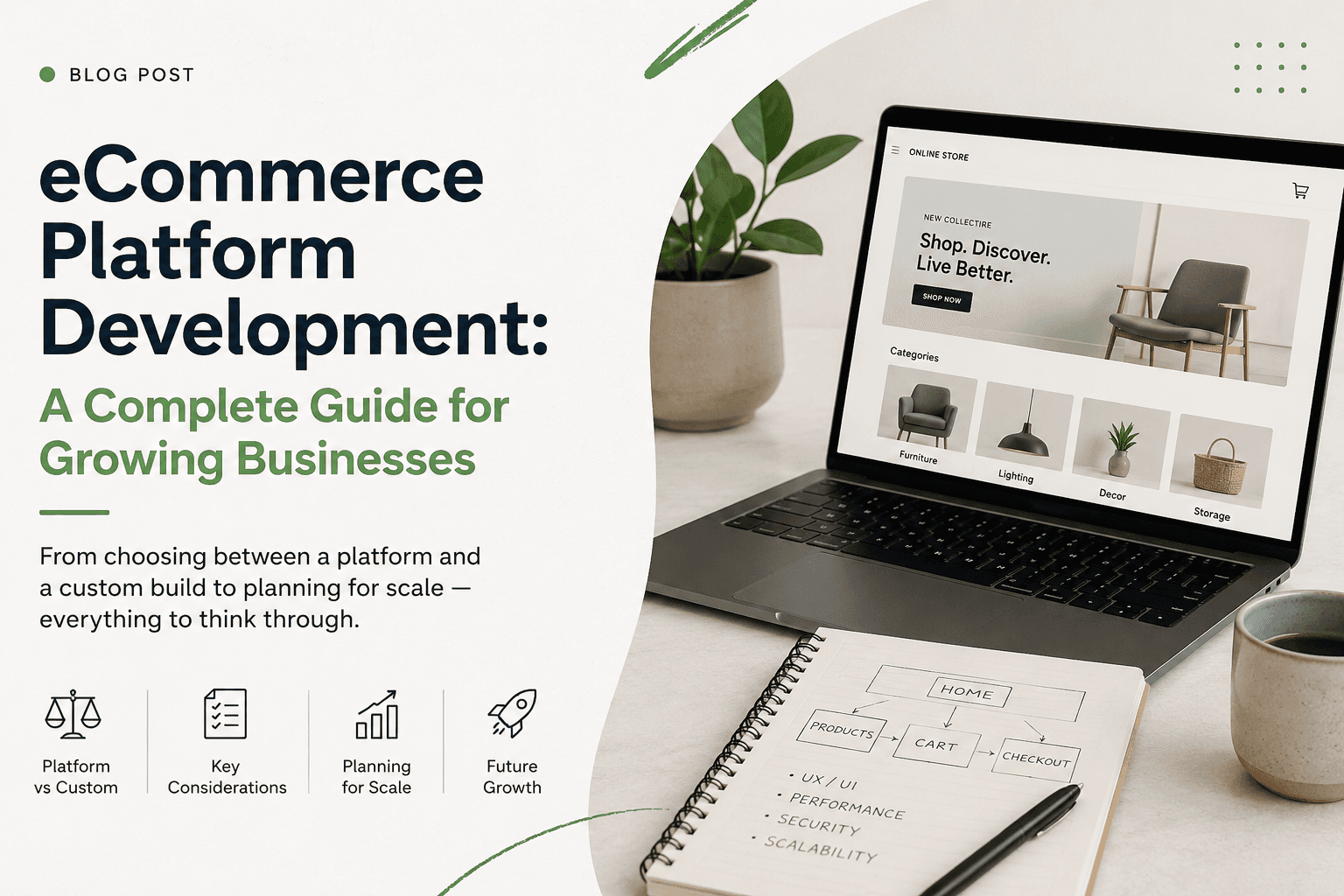
eCommerce Platform Development: A Complete Guide for Growing Businesses
Every growing business eventually asks the same question: should we build on an existing eCommerce platform, or invest in a custom build? The answer depends less on budget and more on how differentiated your buying experience needs to be.
Platform vs. custom: how to actually decide
If your catalog, pricing, and checkout flow look like most other stores in your category, a platform-based approach (with customization) gets you to market faster and with lower maintenance overhead. Custom development earns its cost when your business model doesn't fit the platform mold — multi-vendor marketplaces, complex B2B pricing tiers, subscription-plus-one-time-purchase hybrids, or deep integration with existing inventory and ERP systems.
A good rule of thumb: if you're fighting the platform's data model to represent your business, that's a signal custom development will pay for itself within a year or two.
Payments and checkout: where most conversion is lost
Checkout abandonment is rarely about price — it's friction. Support the payment methods your actual customers use locally (not just international cards), keep guest checkout available, and make sure your checkout flow works cleanly on mobile, since that's where most traffic originates for most storefronts today.
Build in retry logic for failed payments and clear messaging when a payment fails, rather than a generic error. Small details here move conversion rates more than most redesigns.
Inventory and fulfillment need to be part of the architecture, not an afterthought
Stock levels, backorders, and multi-warehouse fulfillment are easy to ignore in an MVP and expensive to retrofit later. If you expect to sell across multiple locations or fulfillment partners, design your inventory model for that from day one, even if you launch with a single warehouse.
Plan for scale before you need it
Flash sales, seasonal spikes, and marketing campaigns can bring 10x normal traffic in a matter of hours. Caching product pages, offloading images to a CDN, and load-testing your checkout flow before a big campaign are far cheaper than firefighting an outage during your highest-revenue day of the year.
What we look at when scoping an eCommerce project
We start every eCommerce engagement by mapping the actual buying journey your customers go through — not a generic funnel — and identifying where a platform can serve you as-is versus where custom logic is worth building. That scoping conversation alone tends to save clients from over-building features nobody will use.
Need help with your project?
Our team can help you plan and build the solution described above.
Get in touch